A Biblical Journey from Creation to Heavenly Canaan
What Does the Bible Teach About Food?
Food is more than a matter of personal preference. Throughout Scripture, what human beings eat is sometimes connected with God’s purpose for their lives, their relationship with Him, and even the story of redemption.
The Bible presents a remarkable progression. In Eden, God gave humanity a simple plant-based diet. Sin brought a curse upon the earth and changed humanity’s relationship with creation. After the Flood, animal flesh was permitted under circumstances very different from those of Eden. Later, when God brought Israel out of Egypt, He again sought to lead His people toward a simpler and healthier diet. And the final picture of Scripture points forward to a restored creation where suffering, death, and violence are no more.
For Christians living near the close of earth’s history, this raises an important question: Could God’s original purpose for human diet still teach us something today?
The answer begins in Eden.
The Diet God Gave in Eden
Before sin entered the world, there was no death, suffering, disease, or violence. Humanity lived in harmony with God and His creation.
The first dietary instruction in the Bible is remarkably clear:
“And God said, Behold, I have given you every herb bearing seed, which is upon the face of all the earth, and every tree, in the which is the fruit of a tree yielding seed; to you it shall be for meat.”
— Genesis 1:29, KJV
The word meat in the King James Bible here simply means food. God directed Adam and Eve toward the fruits, grains, seeds, nuts, and other plant foods that the earth produced.
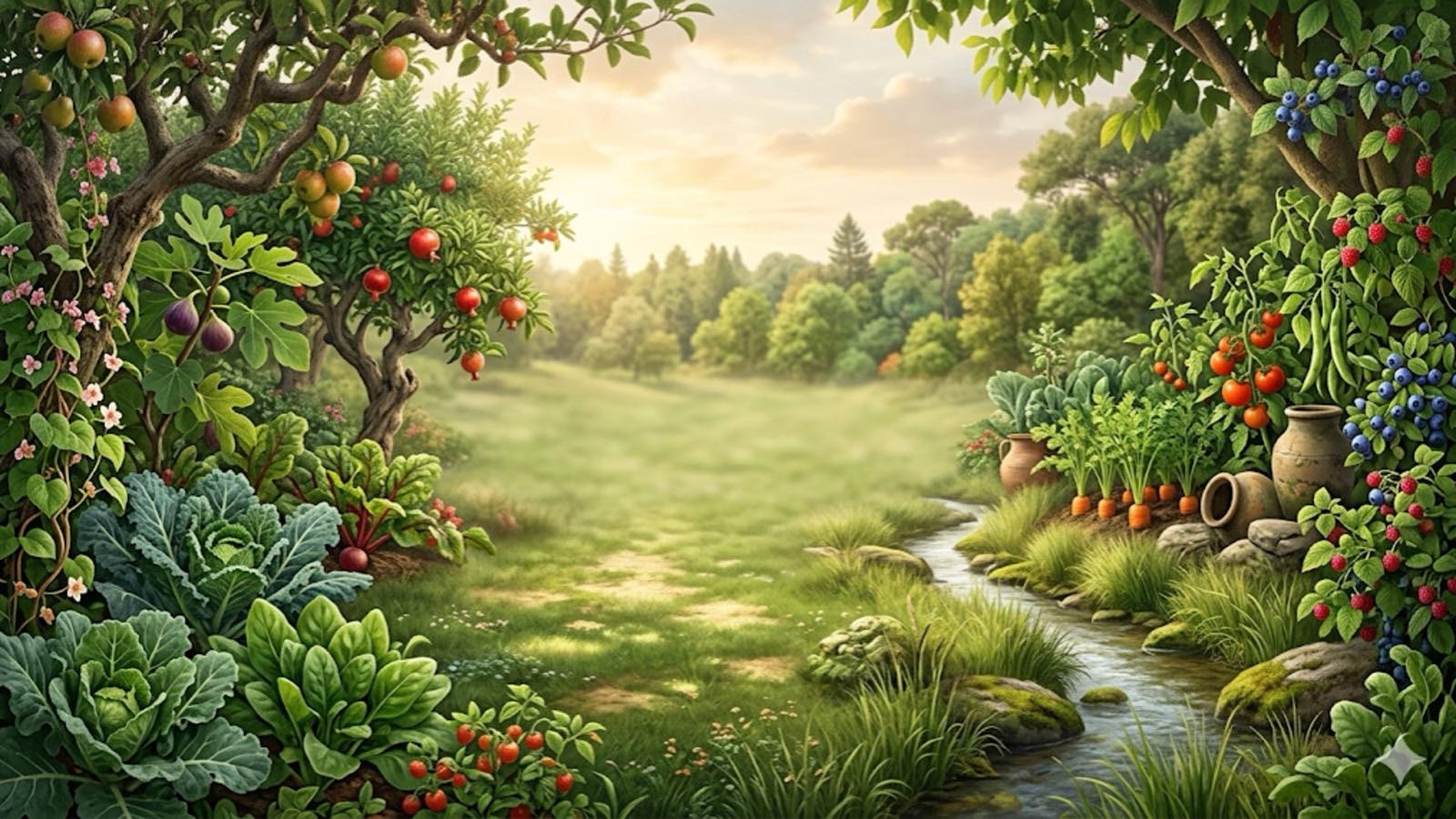
Genesis then describes the abundance of Eden:
“And out of the ground made the LORD God to grow every tree that is pleasant to the sight, and good for food.”
— Genesis 2:9, KJV
There is an important principle here. The first diet given to humanity was not based upon the killing of animals. It was a diet drawn from the abundance of the living creation God had made.
Christian authors express the same principle succinctly:
“Grains, fruits, nuts, and vegetables constitute the diet chosen for us by our Creator.”
— The Ministry of Healing, p. 296.
This does not mean that every person in every circumstance throughout history could simply reproduce the conditions of Eden. The biblical story shows that circumstances changed dramatically. But Eden establishes an important starting point: God’s original design for human food was plant-based.
Sin Changed More Than Our Relationship With God
The entrance of sin affected the entire creation.
When Adam and Eve disobeyed God, the earth itself was placed under a curse:
“Cursed is the ground for thy sake; in sorrow shalt thou eat of it all the days of thy life;
Thorns also and thistles shall it bring forth for thee; and thou shalt eat the herb of the field.”
— Genesis 3:17–18, KJV
Humanity’s environment changed. Work became difficult. The earth no longer produced its abundance as effortlessly as before. Suffering and death entered the world.
But sin also affected the human appetite.
As generations passed, humanity increasingly departed from God’s original simplicity. The account of the antediluvian world describes a society that had become profoundly corrupt:
“And GOD saw that the wickedness of man was great in the earth, and that every imagination of the thoughts of his heart was only evil continually.”
— Genesis 6:5, KJV
Jesus connects this moral decline with the corruption of appetite. The people before the Flood became increasingly self-indulgent, and eating and drinking became objects of excessive desire. The problem was not simply food itself, but humanity’s misuse of God’s gifts and enslavement to appetite.
This is an important biblical principle: appetite is not morally neutral when it controls us.
Interestingly Jesus draws a parallel betwenn the generation before the Flood and the conditions preceding His second coming:
“For as in the days that were before the flood they were eating and drinking, marrying and giving in marriage, until the day that Noe entered into the ark.”
— Matthew 24:38, KJV
Eating and drinking are not sins. Marriage is not a sin. But good things can become destructive when they take the place of God or are pursued without restraint.
The question, therefore, is not merely, “Is this food permitted?” It is also, “What place does appetite have in my life?”
Why Was Flesh Permitted After the Flood?
One of the most important developments in the biblical story occurs after the Flood.
Following the Flood, God told Noah:
“Every moving thing that liveth shall be meat for you; even as the green herb have I given you all things.”
— Genesis 9:3, KJV
At first glance, this might seem to contradict the diet given in Eden. But the circumstances were radically different.
The Flood had destroyed the vegetation of the earth. Genesis tells us that Noah had to wait for the waters to recede and the earth to become habitable again.
The permission to eat animal flesh therefore came after the Flood, in a world dramatically altered by sin and catastrophe. It was not the diet originally given to humanity in Eden.
This helps us understand the biblical picture without pretending that the world after the Flood was still the world of Eden.
God permitted something under altered circumstances that was not part of His original dietary provision.
Egypt, Manna, and the Journey Back
Centuries later, another important dietary lesson appears in the story of Israel.
After delivering His people from Egyptian slavery, God led them through the wilderness. Instead of giving them the rich and luxurious food to which many had become accustomed, God provided manna.
When the Israelites saw it, they asked:
“What is this? for they wist not what it was. And Moses said unto them, This is the bread which the LORD hath given you to eat.”
— Exodus 16:15, KJV
The manna was not merely emergency food. It was God’s deliberate provision for His people.
The Bible says:
“And he humbled thee, and suffered thee to hunger, and fed thee with manna, which thou knewest not, neither did thy fathers know; that he might make thee know that man doth not live by bread only, but by every word that proceedeth out of the mouth of the LORD doth man live.”
— Deuteronomy 8:3, KJV
God was teaching Israel something about dependence, simplicity, obedience, and trust.
But Israel became dissatisfied.
“And the mixt multitude that was among them fell a lusting: and the children of Israel also wept again, and said, Who shall give us flesh to eat?”
— Numbers 11:4, KJV
Their problem was not simply that they wanted a different menu. They had begun to despise God’s provision.
We can see God’s purpose in providing manna as part of a broader effort to restore Israel’s appetite. God desired to give them food better suited to their needs and to lead them back toward the fruits of the earth originally given in Eden.
God intended to remove flesh meats and establish His people as a healthy and strong nation in the land He had promised them.
But Israel resisted the lesson.
They wanted Egypt’s food while travelling toward Canaan.
That makes the wilderness experience particularly relevant to Christians today.
The Wilderness Experience Is a Warning for Us
The New Testament tells Christians that the experiences of ancient Israel were recorded for our benefit.
Paul writes:
“Now these things were our examples, to the intent we should not lust after evil things, as they also lusted.”
— 1 Corinthians 10:6, KJV
And again:
“Now all these things happened unto them for ensamples: and they are written for our admonition, upon whom the ends of the world are come.”
— 1 Corinthians 10:11, KJV
Notice the final phrase: “upon whom the ends of the world are come.”
Israel was travelling toward earthly Canaan. God’s people today are looking toward the heavenly Canaan.
The parallel should cause us to think carefully.
Israel had been delivered from Egypt but still carried Egyptian appetites with them. They had experienced God’s miraculous power, but they were reluctant to surrender their desires. Their journey was not simply geographical. God was trying to transform a people.
The same principle applies to Christian discipleship today. Salvation is not merely about being delivered from the penalty of sin. God desires to restore the whole person.
The Day of Atonement and the Call to Self-Denial
The biblical Day of Atonement was a solemn day of examination, repentance, and self-denial.
God instructed Israel:
“It shall be a sabbath of rest unto you, and ye shall afflict your souls, by a statute for ever.”
— Leviticus 16:31, KJV
And again:
“And this shall be a statute for ever unto you: that in the seventh month, on the tenth day of the month, ye shall afflict your souls.”
— Leviticus 16:29, KJV
For Christians who understand the heavenly sanctuary and Christ’s present ministry as our High Priest, the Day of Atonement carries profound significance.
The earthly sanctuary pointed forward to Christ’s work of redemption. Hebrews tells us:
“For Christ is not entered into the holy places made with hands, which are the figures of the true; but into heaven itself, now to appear in the presence of God for us.”
— Hebrews 9:24, KJV
The focus of the Day of Atonement was not simply what Israel ate on one particular day. It represented a deeper call to self-examination, surrender, cleansing, and preparation to meet God.
This is where the subject of health becomes relevant—not as a means of earning salvation, but as part of allowing God to bring our lives into harmony with His will.
The issue is ultimately one of surrender.
What has authority over me—God, or my appetite?
The Manna in the Ark: A Lesson for the Last Generation
There is a fascinating detail connected with the sanctuary.
Hebrews tells us that inside the ark was:
“the golden pot that had manna”
— Hebrews 9:4, KJV
The manna represented God’s provision for His people during their journey through the wilderness. It was preserved as a testimony of God’s faithfulness and as a reminder of Israel’s experience.
For those living in the closing period of earth’s history, the lesson is especially meaningful.
God once gave His people bread from heaven as they journeyed toward earthly Canaan. He was teaching them to trust His provision and to allow Him to reform their appetites.
Today, Christians are likewise travelling toward a promised inheritance—but this time, toward heavenly Canaan.
The question is not whether we can earn our way into heaven through a particular diet. We cannot.
Salvation is through Christ alone.
But the Christian life involves learning to surrender every area of life to Him. Food is one of those areas.
The goal is not legalism. The goal is restoration.
Health Reform Is Not the Gospel—but It Is Part of Christian Restoration
It is important to make this distinction clear:
The Bible does not teach that vegetarianism saves us. It does not teach that a person’s diet determines whether Christ will accept them. Salvation is a gift of grace through faith in Jesus Christ.
Paul writes:
“For by grace are ye saved through faith; and that not of yourselves: it is the gift of God.”
— Ephesians 2:8, KJV
Yet the same Bible that teaches salvation by grace also teaches that our bodies matter to God:
“What? know ye not that your body is the temple of the Holy Ghost which is in you, which ye have of God, and ye are not your own?”
— 1 Corinthians 6:19, KJV
And:
“Whether therefore ye eat, or drink, or whatsoever ye do, do all to the glory of God.”
— 1 Corinthians 10:31, KJV
Christian health therefore begins with a different question from the world’s usual approach.
It is not merely, “What can I get away with eating?”
It is, “How can I best honour God with the body He has entrusted to me?”
For some people, that may mean beginning to eat more whole plant foods. For others, it may mean giving up on meat, abandoning harmful habits, learning temperance, or simply becoming more conscious of what they consume.
The direction matters.
The Biblical Journey Points Forward
The story of diet in Scripture has a direction.
Eden: humanity receives a plant-based diet.
After sin: the earth is cursed and humanity’s relationship with creation is radically altered.
After the Flood: animal flesh is permitted in a world where vegetation has been devastated and circumstances have changed.
Israel in the wilderness: God provides manna and seeks to bring His people toward a simpler, healthier diet.
Canaan: God intends to establish a strong and healthy people in the land He promised them.
The heavenly Canaan: God restores His creation completely.
The final picture is not one of killing animals for food.
Isaiah describes the restored earth:
“The wolf and the lamb shall feed together, and the lion shall eat straw like the bullock.”
— Isaiah 65:25, KJV
And earlier:
“The wolf also shall dwell with the lamb, and the leopard shall lie down with the kid; and the calf and the young lion and the fatling together; and a little child shall lead them.”
— Isaiah 11:6, KJV
The prophet continues:
“They shall not hurt nor destroy in all my holy mountain: for the earth shall be full of the knowledge of the LORD, as the waters cover the sea.”
— Isaiah 11:9, KJV
This is the ultimate destination of God’s restoration.
There is no suffering.
There is no death.
There is no violence.
And there is no need for human beings to kill animals for food.
Revelation gives us the even greater promise:
“And God shall wipe away all tears from their eyes; and there shall be no more death, neither sorrow, nor crying, neither shall there be any more pain.”
— Revelation 21:4, KJV
The restored creation returns to the harmony that was lost through sin.
The Tree of Life and the Food of the Restored Earth
The final chapters of Scripture return us to imagery strikingly reminiscent of Eden.
John sees:
“a pure river of water of life, clear as crystal, proceeding out of the throne of God and of the Lamb.”
— Revelation 22:1, KJV
And beside the river:
“the tree of life, which bare twelve manner of fruits, and yielded her fruit every month.”
— Revelation 22:2, KJV
The Bible begins with humanity surrounded by the abundant plant life of Eden, and it closes with humanity restored beside the tree of life.
The story has come full circle.
What sin disrupted, God restores.
What death destroyed, God renews.
What humanity lost in Eden, God ultimately gives back in greater glory.
Looking Toward Heavenly Canaan
Perhaps the most important lesson is not actually about vegetarianism.
It is about direction.
God has always been seeking to lead His people from the effects of sin toward restoration.
He called Israel out of Egypt and gave them manna.
He taught them to trust Him rather than their appetites.
He called them to Canaan.
And the New Testament tells us that these experiences were recorded for those living near the end of earth’s history.
Today, Christ calls His people to follow Him toward the heavenly Canaan.
That journey includes the heart.
It includes the mind.
It includes our habits.
And, where we understand God’s will, it includes the way we treat the body He has given us.
The Spirit of Prophecy expresses this broader restoration beautifully:
“There is an open door for you. The light from heaven descending upon Jesus Christ acknowledges that He is accepted as our Substitute, and through faith in Him and obedience to God’s commandments we shall be brought back again to our Eden home.”
— 4LtMs, Ms 84, 1886, par. 4.
That is the real goal.
Not merely a better diet—but a restored relationship with God.
Not salvation through food, but surrender in every area of life.
Not confidence in our own discipline, but dependence upon Christ.
And not simply looking backward to Eden, but forward to the day when God’s work of restoration will be complete.
Jesus promised:
“Blessed are they that do his commandments, that they may have right to the tree of life, and may enter in through the gates into the city.”
— Revelation 22:14, KJV
The Christian’s journey is ultimately a journey home.
From Egypt to Canaan.
From sin to holiness.
From sickness and suffering to restoration.
From a world corrupted by sin to a creation renewed by God.
And, finally, from the brokenness of this present world back to the Eden that God has promised to restore.
As we approach the heavenly Canaan, perhaps the question worth asking is not, “How little can I change?” but, “What would God like to restore in me?”
“Whether therefore ye eat, or drink, or whatsoever ye do, do all to the glory of God.” – 1 Corinthians 10:31